








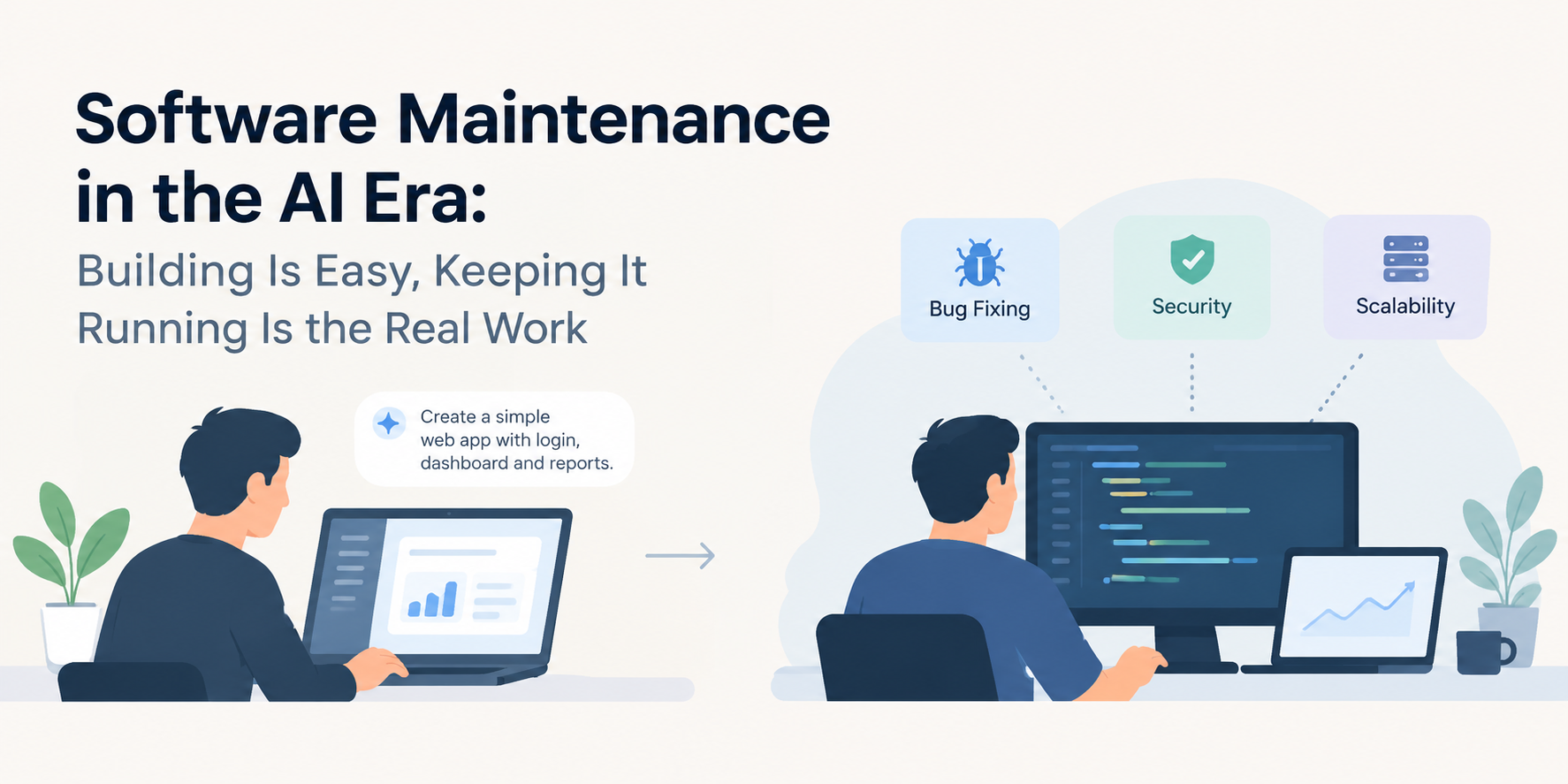
A founder opens an AI tool on Friday evening, describes the app they need, and by Sunday has something that works. Login, dashboard, a few reports. The demo goes well on Monday.
Three months later, the app has real users. A payment fails without any error message. One page takes ten seconds to load. A small change to the pricing logic breaks the invoice screen. Nobody on the team can explain why, because nobody wrote the code in the traditional sense.
This is happening in a lot of companies right now. This article explains why software maintenance, bug fixing, and scaling have become the most important parts of the software story, and what you can do to prepare.
What Has Actually Changed
AI tools have made the first version of almost anything cheaper. Small internal tools, customized dashboards, landing pages, and workflow automations that once took a development team weeks can now be drafted in hours. That is a real and welcome shift, and we use these tools ourselves.
As a result, customization and basic development are no longer the scarce resource they used to be. More people than ever can say, "I will just build it myself."
But the cost of writing code fell. The cost of owning code did not.
Writing Code Is Only the Beginning
Think about the difference between buying a car and owning one. The purchase is one day. Ownership is insurance, servicing, repairs, and replacing parts for years.
Software works the same way. After launch, the world keeps moving. Libraries release updates, browsers change behavior, third-party APIs get deprecated, security patches arrive, and your own business rules evolve. Software that is not looked after slowly stops working, even if nobody touches it.
It is widely accepted in the industry that maintenance makes up a large share of a system's total lifetime cost. The exact figure varies by source, so treat any specific percentage with caution.
Where AI-Built Software Starts to Struggle
Bug fixing without understanding
When the person who prompted the app does not understand the codebase, every bug becomes a guessing game. A common pattern is pasting the error back into the AI, getting a patch, and finding that it fixed one thing and quietly broke another. After a dozen rounds, the code becomes layers of fixes that nobody can fully explain.
Debugging is not just about changing code. It is about understanding why the system behaves the way it does.
Scaling beyond the first hundred users
An app that feels fast with ten users can struggle with ten thousand. Database queries that were fine on small data become slow. Background jobs pile up. Two users editing the same record at the same time cause strange errors.
Scaling is mostly about architecture: how data is structured, where caching belongs, how work is queued. These decisions are made early, and generated code rarely considers them unless someone knows to ask.
Security and data safety
Login systems, permissions, input validation, and secret keys need careful handling. Generated code can look correct and still contain weaknesses, such as access checks that are missing or credentials left in the wrong place. If your software handles customer data or payments, a review by an experienced engineer is not optional.
The missing knowledge
Professionally built software usually comes with tests, documentation, and people who remember why certain decisions were made. AI-built software often has none of that. When something breaks at 2 AM, there is no one to call and nothing to read.
A Realistic Scenario
Here is an illustrative example, not a real case study. A small online retailer builds an order management tool with an AI assistant. It works well through the first few months. Then a seasonal sale triples the order volume.
Orders start duplicating. The inventory count drifts. A fix for one problem causes another. The owner spends the sale week firefighting instead of selling, and eventually asks a development team to step in. That team spends the first days not building anything new, but simply reading the code to understand what exists.
This is the pattern we see: the build was fast, but the recovery was slow.
What Businesses Can Do Now
You do not need to avoid AI. You need to use it with open eyes. A few practical steps help:
- Use AI to prototype and test ideas quickly, then decide deliberately which ideas deserve a production-grade version.
- Ask an experienced engineer to review the code before real customers or real money are involved.
- Add monitoring, error logging, and regular backups from the start, so problems are visible before users report them.
- Write automated tests for the flows that matter most, such as payments, login, and data exports.
- Keep basic documentation: what the system does, where it runs, and how to deploy it.
- Decide who owns the software after launch. Someone must be responsible for updates, incidents, and improvements.
None of this is glamorous, but it is exactly what separates a demo from a dependable product.
Where This Leaves Us
AI will keep improving, and it will help with maintenance too. It already helps developers read unfamiliar code, write tests, and trace errors faster. But accountability stays with people. Someone has to decide what the system should do, notice when it does not, and take responsibility for fixing it.
The most valuable skill in software is moving from "can we build it?" to "can we keep it healthy for years?" At iNiLabs, this is the part of the work we care about most: reviewing, stabilizing, maintaining, and scaling software so that it keeps serving the business long after launch day.
If you have built something with AI and want an honest second opinion on its readiness, we are happy to take a look.
FAQ Section
- Can AI-generated code be used in production?
Yes, but it should be treated like code written by a new junior developer: useful, fast, and in need of review. Test, run security checks, and monitor it before real users depend on it.
- Why does software need maintenance if nobody changes it?
Because everything around it changes: dependencies, operating systems, browsers, and external services all evolve, and unpatched software becomes less secure and less compatible over time.
- What is technical debt in simple terms?
It is the future cost created by quick shortcuts today. Like financial debt, it can be useful in the short term, but it grows with interest if it is never addressed.
- When should a business bring in a development team for an AI-built app?
Ideally before launch, or at the first sign of trouble such as recurring bugs, slow performance, or growing user numbers. Early review is usually cheaper than a rescue later.